
What the European Accessibility Act Means for Your Brand
Lucy Todd | 15 July 2025 | 5 mins
The European Accessibility Act (EAA) comes into effect in June 2025, and if your brand sells digital services or products to consumers within the EU, it's time to take notice. For marketing leaders, this isn’t just a legal box to tick, it’s a chance to improve user experience, boost performance, enhance your brand reputation, and most importantly, do the right thing for people.
The World Health Organisation states that 16% of the world’s population lives with some form of disability, and the European Accessibility Act is about removing barriers that stop people with disabilities from fully taking part in everyday life. Whether it’s using a website, buying a train ticket, reading an e-book, or accessing online banking, the Act makes sure that these things are designed so that everyone can use them, including people who are blind, deaf, or have physical or cognitive disabilities.
While the EAA applies to various digital products and services, this article will primarily focus on websites and web-based digital experiences, where most marketing teams have direct influence. So, how can you ensure your brand is compliant? Let’s dive in.
What Is the European Accessibility Act?
The European Accessibility Act is an EU directive designed to ensure equal access to digital products and services for people with disabilities. It affects websites, mobile apps, e-commerce platforms, ticketing services, e-readers, and more, with a focus on consistency across the EU single market.
From June 28, 2025, any business offering services to consumers in the EU must meet accessibility requirements defined in harmonised EU standards, which, for websites, are largely aligned with the Web Content Accessibility Guidelines (WCAG) 2.1 Level AA.
What Does the EAA Mean for Your Brand?
If you’re part of a marketing team, accessibility isn’t just the developer’s problem, it directly impacts your:
Brand trust and reputation – Inclusive design shows your brand cares about all users.
Reach and conversions – An accessible site opens the door to millions of users who may otherwise be excluded.
Legal compliance – Avoid fines, litigation, and the cost of retrofitting inaccessible platforms.
Sustainability and ESG goals – Accessibility aligns with your environmental, social and governance commitments.
What does this mean for your team?
It’s important that accessibility is known and practised throughout your teams, which can be supported with training for marketing, content, and dev teams, to spot and fix accessibility issues early. Supporting your team on the implementation and ensuring your website is prepared for the EAA can be found in our article here.
When your digital experience aligns with the values your audience already associates with your brand, such as care, equality, or innovation, it strengthens that perception through confirmation bias, deepening brand affinity.
How Can You Implement Accessibility into Design?
Accessibility should be embedded from the start of your digital projects and not retrofitted later. Here are some key ways to integrate it into your design and development workflow:
1. Design with empathy
Use inclusive design principles to create interfaces that work for all users, including those with visual, auditory, cognitive, and motor impairments.
2. Follow WCAG 2.1 AA guidelines
Ensure your team is familiar with the Web Content Accessibility Guidelines (WCAG), which outline specific success criteria like colour contrast, keyboard navigation, text alternatives for media, and more.
3. Use semantic HTML and ARIA roles
Correct use of HTML structure and ARIA attributes ensures assistive technologies can correctly interpret and navigate your site.
4. Test with real users and assistive tech
Use screen readers, voice control, and keyboard-only navigation during user testing to catch real-world barriers.
5. Make accessibility part of your QA
Bake accessibility into your quality assurance and development pipelines, with automated tools like Axe or WAVE as a first pass.
6. Educate content teams on accessible publishing
Marketing and content teams should understand how to write descriptive alt text, structure headings logically, maintain sufficient colour contrast, avoid “click here” links, and use inclusive, plain language. Training or internal guidance helps keep accessibility front of mind whenever new content is added.
Does Accessibility Affect Performance?
Yes, and in a positive way. Accessible websites tend to be faster, better optimised, and more user-friendly. Here’s why:
Cleaner code and structure improves load speed and SEO
Mobile-friendly design helps all users, not just those with impairments.
Simplified navigation and clarity increase engagement and conversion rates by creating cognitive ease, making the experience feel more intuitive, trustworthy, and pleasant for all users.
It’s also important to note that if your brand uses third-party platforms (like CMS, plugins, or analytics tools), those need to meet accessibility standards too.
In essence, what’s good for accessibility is also good for performance and SEO, and making it a win-win for marketers and developers alike.
What Is an Accessibility Score?
An accessibility score is a measurable indicator of how well your website or digital product adheres to recognised accessibility standards, typically based on the WCAG 2.1 guidelines. It helps brands understand where they stand and identify areas for improvement.
Accessibility scores are often generated through tools such as:
Lighthouse (by Google) - part of Chrome DevTools, providing a score out of 100.
WAVE - a browser-based tool offering visual feedback on accessibility issues.
Axe DevTools - widely used by developers to catch WCAG violations.
These tools scan your website for common barriers like poor colour contrast, missing alt text, or incorrect heading structures. While automated tools can’t detect every issue, an accessibility score gives a quick, high-level view of how inclusive your site is.
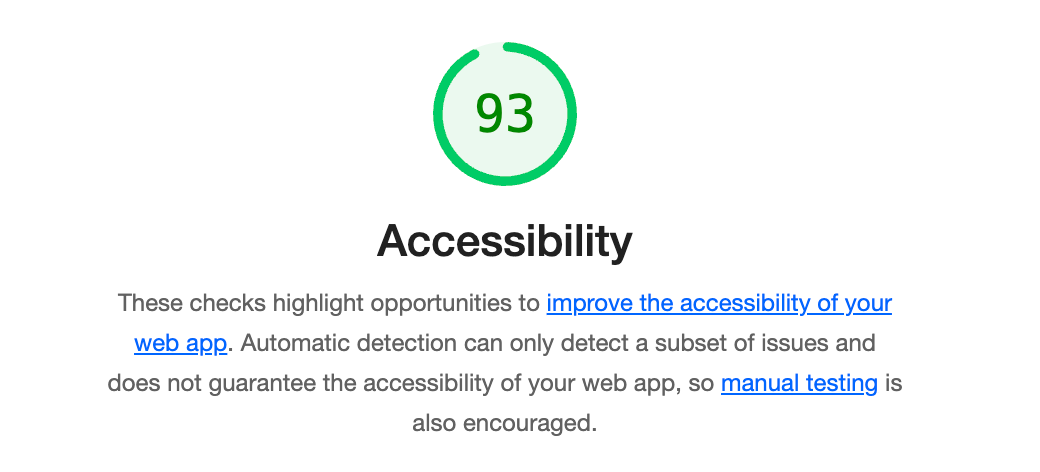
Ref: Lighthouse (by Google)
Why Does It Matter?
A low score highlights potential risks of non-compliance with the European Accessibility Act
It reveals UX and performance gaps that may be affecting conversions
Tracking your score over time helps show progress and accountability
Accessibility Statement
One essential but often overlooked requirement of the European Accessibility Act is the need for an Accessibility Statement. This is not just a best practice, it’s a formal compliance obligation.
An Accessibility Statement is a public declaration that outlines:
The current level of accessibility of your website or digital service
Any known limitations or areas that do not yet meet accessibility standards
How users can report issues or request accessible alternatives
The methods used to assess accessibility (such as audits or user testing)
This statement demonstrates your organisation’s transparency and ongoing commitment to inclusion. It’s also a valuable tool for user feedback, helping you prioritise future improvements based on real-world needs.
To comply with the EAA, ensure that your Accessibility Statement:
Is published on your website and easy to find (typically linked in the footer)
Is written in plain language and accessible itself
Is regularly reviewed and updated, especially after major changes or audits
Whilst you ensure your statement is regularly reviewed and updated, ongoing maintenance is important for the overall design too, it isn’t a one-off effort. Periodic testing and updates are necessary, especially when new content or features are added.
Making your Accessibility Statement part of your digital governance process helps show due diligence and keeps you on the right side of the law, while reinforcing trust with your users.
Key Takeaways
The European Accessibility Act becomes enforceable on June, 28th 2025 – make sure your brand is ready.
This is about more than compliance; it’s about inclusion, brand reputation, and digital performance.
Embed accessibility from day one, across design, development, content, and testing.
Ensure you carry out regular audits and keep track of your accessibility score, and keep your accessibility statement visible and up to date.
Accessible websites perform better in search, are more usable, and futureproof your digital strategy.
At LAB, we help forward-thinking brands design and develop accessible, high-performing digital experiences that reach more users and create an inclusive online experience.
Get in touch with our team to audit your site, where we can help improve your accessibility score, or embed inclusive design into your next digital project.