
What is the COM-B Model and How is it Shaping Our Digital Experiences?
LAB | 6 August 2025 | 10 mins
Brands have long strived to find powerful, effective ways to transform how consumers feel about their products, services, or business personas – and, for many, it's almost impossible to get to the underlying reasons a concept, digital product, or design iteration simply doesn't have anywhere close to the impact you'd hoped for.
COM-B is a behavioural model with excellent potential for uncovering the answers. It's increasingly being used to inform and enhance the design choices that go into digital products, UX, and user engagement strategies that deliver real returns.
What exactly is COM-B?
COM-B is a behaviour change model that states behaviour (B) is influenced by three factors: capability (C), opportunity (O), and motivation (M). All three must be present for a behaviour to occur.
As an evidence-based model, COM-B isn’t based on guesses but a robust, proven behaviour change framework that puts you in your consumer’s shoes.
You're never assuming why they're not keen on your product; instead, you know precisely the barriers to engagement that are getting in your way.
This all relies on breaking down three components, capability, opportunity, and motivation, to drill down into why behaviours happen and the right ways to turn that around: hence the COM-B name, an abbreviation of Capability, Opportunity, Motivation, and Behaviour!
An Introduction to the COM-B Model: Incorporating Behavioural Psychology Into Digital Experience Design
COM-B is a relatively recent concept in behaviour change strategy. It was developed by a team of three, Susan Michie, Maartje van Stralen, and Robert West, just 14 years ago.
The authors went on to create the Behaviour Change Wheel, published in 2014. It was the result of an in-depth systematic literature review project that incorporated 19 different frameworks of behaviour change.
If we had to create a short, sharp summary to clarify what COM-B is and how it works, we’d explain it like this:
It looks at the three COM factors and works on the basis that all three things need to happen or be present for any change in behaviour to occur.
COM-B tells digital product owners what needs to change for any intervention or design tweak to be effective.
That means that if your target audience doesn't believe they have the capability to engage in a product, use a service, or join a community, they won't, nor will they have any reason to engage if they've not yet done so, if there isn't any opportunity or motivation to act.
The Components of COM-B Modelling
Perhaps the easiest way to comprehend how COM-B works in action is to break down the three elements to explain why, if any of them are lacking, behaviour change won’t happen.
Capability can be either physical or psychological, but it means a user needs to think they have, for example, the right skills, knowledge, or fitness level to take part in an activity or engage with a service.
Opportunity refers to external factors that enable the target user to respond and perform the intended behaviour, whether having the time, internet connection or capacity to engage.
Motivation is fairly self-explanatory. It refers to the internal processes we use, either intuitive, natural responses or reflective behaviours, to help us make decisions and encourage us to change a behaviour.
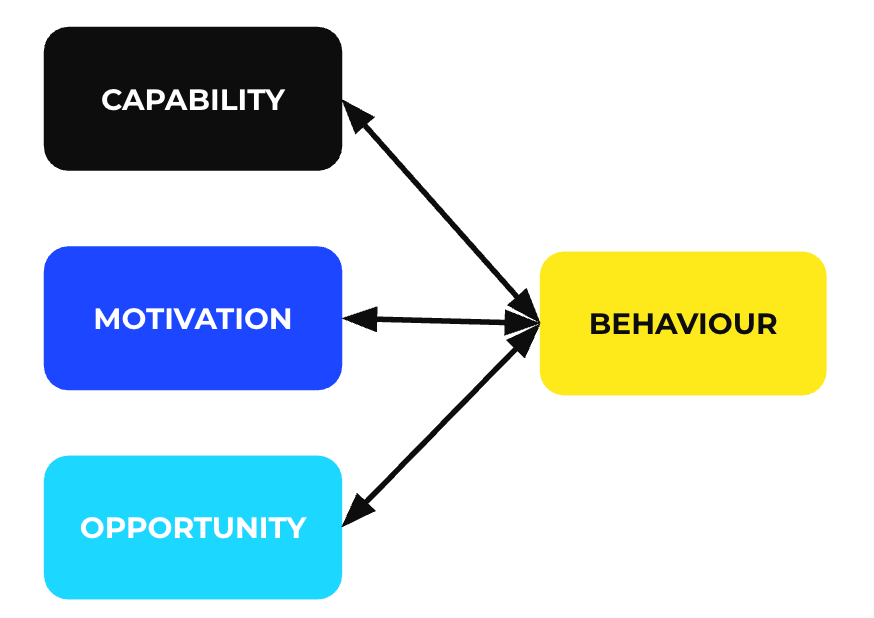
A lot will depend on the nature of a digital product. Still, the takeaway is that if a brand can create products and marketing communications that change perceptions and show individuals they have each of the three elements, the chance of affecting real behaviour change is dramatically higher.
Why COM-B Matters in Digital Design
We all know that understanding your users, what they want, and how to design interfaces, apps, and products they feel comfortable with and enjoy using is fundamental to creating positive user experiences. As a diagnostic tool, COM-B helps highlight barriers, so you know where work is needed.
Designing products or solutions in a silo rarely works because you need to know how to influence the capability, opportunity and motivation of your intended users to design products that remove any existing barriers.
It's also common for brands to be left in the dark without any way to diagnose why users aren't taking action or what makes one product amazingly successful while another falls flat.
Rather than producing endless versions or making random improvements on the off-chance, COM-B gives you a platform to analyse each of the three components, unpick the sticking points, and be strategic about how you deploy resources to fix them.
COM-B in Action: Digital Experience Examples
Looking at COM-B in real life is a great way to visualise how this all works and why it's such an effective approach to digital experience design.
We’ve put together a cheat sheet of some of the best current examples on the market and summarised what each does to address those three components of COM-B modelling.
Capability
Brands are using approaches such as in-app tutorials, onboarding flows that help users build new entry-level skills, and tooltips – a type of short, informative pop-up message that provides added-value explanations, guidance, or advice.
Working out or starting to run can be daunting for beginners, especially when they may not know where to start. Fitness apps like Nike Training Club utilise gradual plans tailored to beginners, who are still building their confidence. By providing plans tailored to people’s physical capability, they make workouts easier and more accessible, that anyone can feel comfortable using.

These interventions can broaden user demographics by widening appeal, ensuring a digital product is genuinely accessible, and removing those obstructions that could have led proportions of audiences to assume the product wasn’t for them.
Opportunity
Design attributes like reminders, notifications, and prompts can activate user reactions, and brands can reduce barriers to entry by ensuring their marketing clarifies how easy it is to start or that new users only need simple hardware, such as a phone and headphones, to join.
When you need to get from A to B quickly, you want to be able to arrange that quickly too, that’s why Uber utilises opportunity modelling by providing a simplified way to request transport in just a few taps. By ensuring a seamless and quick user journey, it makes it far easier for consumers to use their service without needing to hail down a cab in person, have a phone number for a local taxi company, or own a car to travel.

Brands can encourage interaction and engagement by either communicating the opportunities that exist or removing issues that might prevent users from using them.
Motivation
More personalised, targeted content, reward loops that recognise repeat interactions or progress, and emotional design elements can all enhance motivation and improve the satisfaction a user feels when interacting with a digital product.
At the end of a long day, we may need to decompress to relax, so when our stress levels are elevated, such as the end of the day, Calm uses motivational techniques by sending push notifications at these specific times. This encourages users to regulate their emotions when they need it most and remember to log into the app at pertinent moments.

If brands can combine all three components, boosting users' capability to get involved, providing the opportunity to do so, and using motivation to keep them there, they stand to make vast improvements in their digital experiences and customer perceptions.
There are some great examples of digital products that do this very successfully, and if you'd like to review this in real-time, we'd point to the Couch to 5K App as one case study.
Benefits of Using COM-B in UX
COM-B isn’t just a nice-to-have when it comes to innovative UX; it's a tool that ensures brands develop user-centric designs that work for their users. It is based on a deep understanding of barriers to behaviour to ensure every design choice is based on the needs and preferences of the intended audience.
It leads to more intentional, supportive experiences, where designers make informed decisions backed by data that shows them the factors most relevant to their user groups and prioritise their time and efforts on addressing the most prevalent barriers.
Thirdly, COM-B can benefit digital brands by improving engagement, retention, and conversions. It employs behaviour-aware design to deliver a smoother, more intuitive user experience with clear instructions, tutorials, user-friendly interfaces, and access to resources.
Ethical Considerations When Using COM-B Models
Like almost every behaviour change model, COM-B must be deployed ethically and with care. It was created to empower brands to augment designs for the benefit of their users rather than manipulate behaviours in any way.
Digital product users should always retain autonomy, without pressure or coercion into adopting a behaviour.
Interventions should be monitored regularly, ensuring they’re achieving the desired outcomes without negative impacts.
Behavioural design must align with the user's own goals rather than being used solely for commercial gain.
Provided COM-B is applied thoughtfully, it can transform how we build digital products and ensure they are genuinely intuitive, helpful, and resonate with users' real-world needs.
Key Takeaways
COM-B as a behaviour change model: COM-B stands for Capability, Opportunity, Motivation, and Behaviour. All three elements must be present for a behaviour change to occur, making it a comprehensive framework for understanding user engagement.
Transforming digital experiences: By identifying the barriers to behaviour through the COM-B model, brands can create more intuitive, user-friendly digital products. This approach moves away from guesswork, focusing on evidence-based design.
Real-world applications: Successful digital experiences use COM-B principles by enhancing user capability (like guided tutorials), increasing opportunity (simplifying actions), and boosting motivation (using rewards or personalised content).
Benefits for UX and engagement: Incorporating COM-B in UX design leads to better user engagement, satisfaction, and retention by aligning product design with users' capabilities, opportunities, and motivations.
Ethical considerations: While COM-B offers valuable insights, brands should use it ethically to support users rather than manipulate behaviours, ensuring interventions align with users' own goals.
The COM-B model offers a powerful lens for understanding and influencing behaviour in digital environments. If you’re keen to apply these concepts to your own digital products, please get in touch.
We'd lovw to explain how it all works or discuss a COM-B analysis to see where your users lack capability, opportunity, or motivation and what you can do to change that.